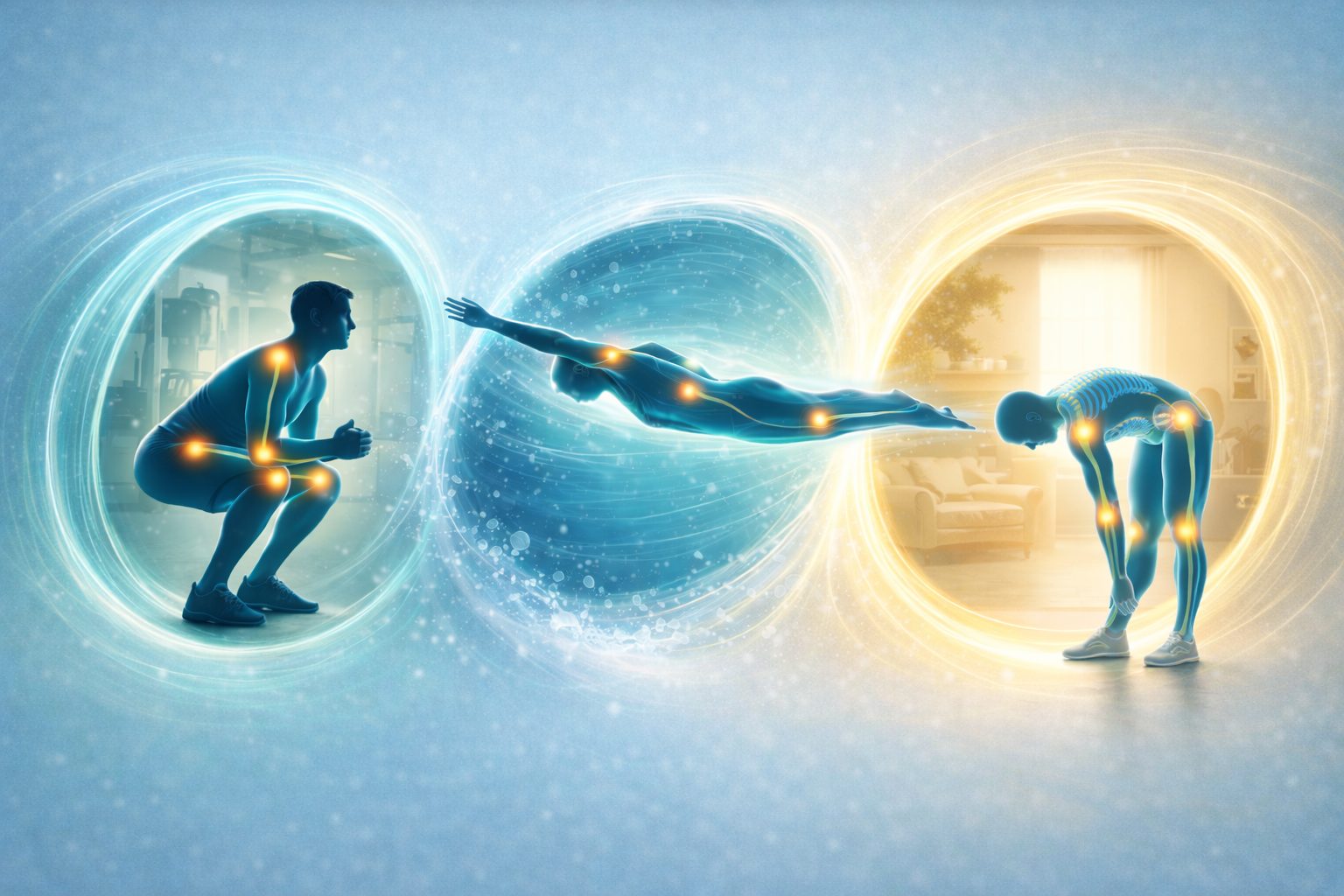
Mobility is one of those words that gets thrown around constantly in the fitness industry.
Sometimes it means stretching. Sometimes it means flexibility. Sometimes it’s code for rehab.
The word gets used so often that it starts to lose definition.
At Motive Training, we define mobility as usable range of motion—the ability to actively control your joints through the positions your life demands.
But I wanted to zoom out.
Mobility doesn’t belong to one system or one profession. It shows up in healthcare, hospitality, swimming, strength training, caregiving, and beyond. So I asked a simple question to professionals across different disciplines:
What does mobility mean to you?
The answers were thoughtful, practical, and deeply human. As I read through them, a few clear themes emerged.
Mobility Is Control
Several professionals described mobility not as range, but as controllable range.
“Mobility is the active range of motion available to us. This means positions we can reach with control, produce force from and have stability in…”
– Richard Bennett, Strength & Conditioning Coach
“Mobility is the capacity to move well through the ranges of motion you actually need in daily life and sport, with control.”
– Hans Graubard, COO & Cofounder, Happy V
Control is the common thread.
Not how far you can go, but whether you can stabilize, generate force, and repeat movement under load. That distinction matters. Passive flexibility might allow you to access a position, but mobility requires ownership of that position.
When we train mobility, we’re not chasing deeper positions. We’re building strength inside the ranges that matter.
Recent Article: Posture: The Ongoing Fight Against Gravity
Mobility Is Independence
Another theme that surfaced repeatedly was independence.
“Mobility is the ability to move your body through functional ranges of motion without pain or restriction. It’s what allows us to perform daily tasks and gives us the freedom to live fully and independently.”
– Amanda Hull, Hull Health
“Mobility to me means the ability to move with change in position, location or circumstance without losing balance.”
– Stephen Huber, President and Founder, Home Care Providers
Outside the gym, mobility determines whether you can get off the floor, climb stairs, carry groceries, or recover from a stumble.
When mobility declines, life narrows. Tasks become cautious. Movement becomes guarded. Small hesitations add up.
Mobility, in this sense, isn’t about performance metrics. It’s about preserving autonomy.
Mobility Is Safety
In some fields, mobility is directly tied to safety.
“For me, mobility is the ability to move through water and life with confidence, control, and safety.”
– Alena Sarri, Owner Operator, Aquatots
“Mobility clinically means being able to move around your environment safely and with confidence… It also involves how well you balance, perceive your surroundings and process that information in your brain.”
– Dr. Gregg Feinerman, FACS
Mobility extends beyond joints and muscles. It includes perception, balance, and coordination. It reflects how well the nervous system integrates information and responds to it.
Mobility Is Adaptability
“Our bodies are meant to move, but they are also incredibly good at adapting to the positions we hold most often… when you’re spending your days and evenings glued to a computer, your body literally starts to take on the shape of your chair.”
– Solveig Eitungjerde, Certified Health Coach
Mobility doesn’t disappear randomly. It narrows because exposure narrows.
Hips stay flexed. The thoracic spine stiffens. The neck drifts forward. Over time, other areas compensate to keep things moving.
The body adapts to what you repeatedly ask of it. If the demands are limited, your options become limited.
Mobility training restores variability. It gives joints alternative strategies before compensation becomes discomfort.
Mobility Is Confidence
“Mobility is the freedom to move through your life–your body, your schedule, your city, your choices–without pain, fear, or apology.”
– Julia Pukhalskaia, CEO, Mermaid Way
There’s something important in that phrasing: without fear.
When joints feel unreliable, hesitation creeps in. You brace before bending. You avoid certain movements.
When joints feel strong and controlled, that hesitation fades. Confidence in motion is quiet. It shows up as fluid transitions and fewer compensations.
Mobility Is Longevity
“Mobility is your ability to move through your day with control… It is not just fitness. It is function.”
– Dr. Cameron Rokhsar, MD FAAD FAACS
Function determines recovery. Function determines independence. Function determines quality of life.
Mobility isn’t a warm-up or a trend. It’s infrastructure. When joints maintain usable range and control, other systems benefit.
The absence of mobility is subtle at first, but its impact compounds over time.
Mobility Reduces Friction
“Mobility is the practical ability to move through your day without unnecessary friction, pain, or fatigue…”
– Damien Zouaoui, Co-Founder, Oakwell Beer Spa
This definition works because it’s simple.
When joints move well, your day feels smoother. You transition from sitting to standing without thinking about it. You walk without guarding.
Friction in the body rarely announces itself loudly. It shows up as subtle compensation or low-grade fatigue.
The Common Thread
Across industries, the themes overlap more than you might expect.
Mobility is control. Mobility is independence. Mobility is safety. Mobility is adaptability. Mobility is reduced friction under load.
It is not extreme range. It is not passive stretching. It is not a single drill or class.
Mobility is capacity; the ability to move through the positions your life requires without hesitation, collapse, or compensation.
At Motive Training, that is why we train it.
Not because it is trendy. Not because it looks impressive.
But because life keeps asking your joints to move, stabilize, and adapt. And if they cannot, something else will pay the price.
That is what mobility means to us.
And based on these perspectives, it means something very similar everywhere else.
Brian Murray is a mobility coach with sixteen years of experience helping people move better, feel stronger, and train without pain. He’s the founder of Motive Training, a personal training facility in Austin, TX, and the creator of Motive Mobility, an online platform focused on joint health and movement longevity. Drawing from Functional Range Conditioning (FRC), WeckMethod, and years of hands-on coaching, Brian’s approach bridges the gap between mobility and performance—making complex concepts simple and actionable for anyone who wants to train and move with purpose.
Leave a Reply