Posture: An Ongoing Fight Against Gravity
By Brian Murray Updated

For years, the importance of posture has been a topic of debate. Some experts claim there’s a correct way to sit or stand. Others dismiss it, pointing to research showing that posture isn’t a direct cause of pain.
The truth is more nuanced.
Research tells us that no single posture keeps everyone safe. People with slouched backs or forward heads aren’t guaranteed to hurt, and plenty of people with textbook alignment still struggle with discomfort. What matters more is movement variety: changing positions and having the capacity to tolerate them.
But here’s the problem: modern life has made posture matter more than ever.
Gravity Meets Modern Living
We’ve always had to fight gravity. It pulls us down every second of every day. But fifty years ago, people weren’t tethered to laptops for ten hours, glued to phones for the rest of the night, and commuting in between.
Now we’re more sedentary, less tuned into how our bodies move, and often holding positions that work against us. Gravity hasn’t changed; our relationship with it has.
That’s why posture is worth a closer look.
What Poor Posture Really Looks Like
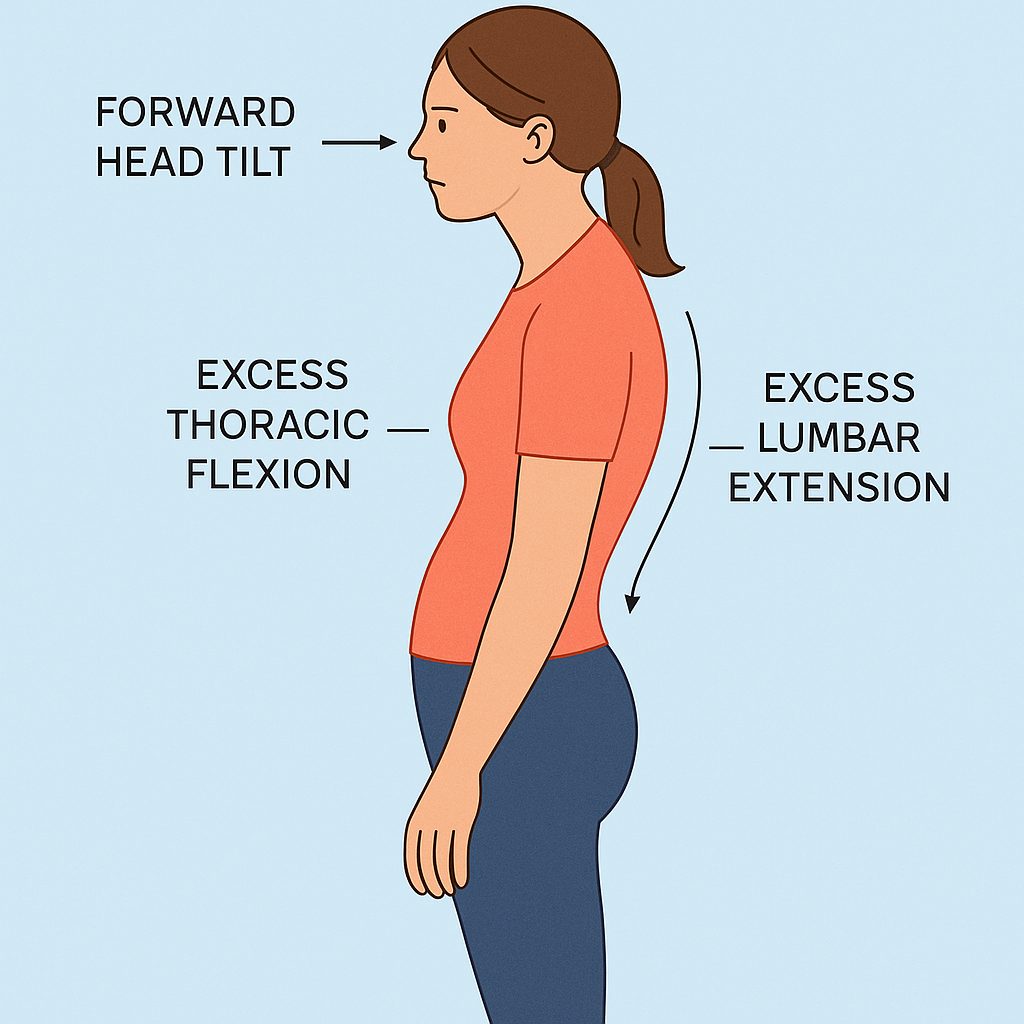
When most people picture poor posture, they imagine slouching. But the patterns are broader and more predictable:
- Forward head tilt: the chin juts forward, straining the neck.
- Excess thoracic flexion: the ribcage collapses, mid-back rounds.
- Excess lumbar extension (anterior pelvic tilt): the lower back arches, and the pelvis tips forward.
These aren’t random. They’re energy-saving defaults. The body takes the path of least resistance, dumping into passive structures instead of actively holding posture. Do it long enough, and the default becomes the norm.
Posture isn’t just about how your shoulders or neck look in isolation. It’s a full-body reorganization around gravity. And more often than not, it begins in the hips.
Why the Hips and Spine Are the Key
The lumbo-pelvic-hip complex (hips, pelvis, and lumbar spine) sets the stage for posture. Long hours of sitting or standing with poor mechanics reduce the independence of these structures.
When the hips can’t move freely or the pelvis gets locked into one orientation, the lumbar spine has to compensate. Once that happens, everything else (feet, ribcage, and head) shifts to maintain balance over gravity.
Posture is not just a slouched spine or rounded shoulders; it’s a cascade of compensations from the ground up.
How the Body Self-Organizes
Humans are efficient. We always find the path of least resistance.
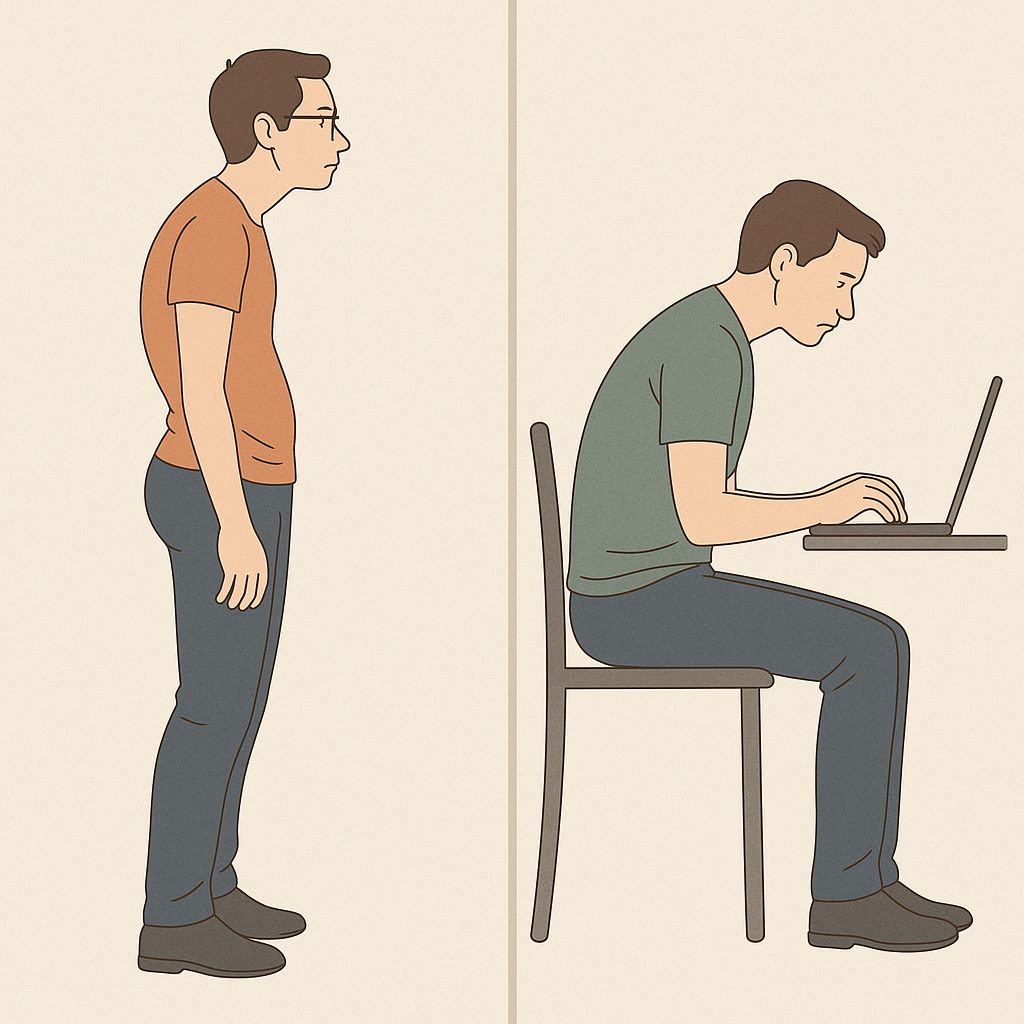
That’s why people tend to fall into flexion while sitting and extension while standing. The body hangs on joints and passive tissues instead of maintaining active support. It’s not laziness; it’s survival. But over time, this “economy” limits options, and posture gets stuck.
This is why posture matters: not because there’s one ideal, but because losing options means losing adaptability.
Different Lenses on Posture
This brings us to a few schools of thought that push the conversation forward. Each takes a different perspective, but all agree that posture deserves more attention than it usually gets.
Strength/Functional Training: Posture as Load Management
Traditional fitness models have long treated posture as a matter of alignment, emphasizing phrases such as “stand tall,” “shoulders back,” and “core tight.” The intent was good, but the focus became rigidity rather than adaptability.
Posture isn’t a static position; it’s a skill under load.
There’s a shift happening in the strength and functional training world, slowly. More coaches are recognizing that posture isn’t just about how you look in stillness, but how well you handle force in motion. Still, much of the industry continues to treat posture as something to lock in instead of something to manage dynamically.
At its best, strength training aligns perfectly with postural development. Good posture is control under stress: your ability to distribute tension, maintain structure, and adapt when gravity and external forces act on you. But when posture breaks down under load, it’s rarely because you forgot to “brace.” It’s because your system couldn’t share tension through the hips, spine, and ribcage.
That’s the gap between traditional fitness and postural efficiency. Strength is essential, but bracing through every rep, every exercise, and every position teaches the body to grip, not to adapt.
A strong spine isn’t one that never moves. It’s one that can flex, extend, and rotate when it needs to, without losing its ability to bear load.
The strength world is catching up to this idea, but it’s taking time. The future of training will shift from rigidity to resilience, from bracing to breathing, and from stiffness to control.
Seen through this lens, posture isn’t about fixing alignment; it’s about building the awareness and capacity to stay organized when things get heavy, under a barbell or under the constant pull of gravity.
Fascial Integration & Full-Body Coordination: Functional Patterns (FP) & WeckMethod (WM)
Both Functional Patterns (FP) and WeckMethod (WM) root their systems in what they call the fundamental human motions: walking, running, and throwing. From their perspective, posture isn’t an isolated alignment problem but a product of how well we perform and integrate those primal patterns.
FP emphasizes gait, rotation, and fascial tension: the interconnected web of tissue that transmits and stores elastic energy throughout the body. The idea is that every joint, muscle, and connective line plays a role in distributing force efficiently through these foundational movements. When that integration breaks down, posture suffers.
WM builds on similar principles, focusing on the rotational and coiling mechanics that enable the spine and ribcage to transmit force between the upper and lower body. These spiral patterns represent a more realistic model of how humans move, rarely in straight lines and almost always with rotation.
Both systems approach posture as an expression of global integration rather than local correction. Instead of pulling your shoulders back or tucking your pelvis under, FP and WM teach you to organize movement around gravity and tension in motion.
Their approaches can lean heavily on the concept of a “biomechanical blueprint,” which is not yet fully supported by research, but their underlying principle holds: posture isn’t just something you hold. It’s something you create through motion.
Inside-Out Capacity: Functional Range Conditioning (FRC)
If FP focuses on the global system, FRC works from the inside out. It asks a simple but profound question: Do your joints have the capacity to move and control force on their own?
Without that capacity, global posture doesn’t matter. You can’t integrate what you don’t own.
FRC views posture as a byproduct of joint function. The better your hips, spine, and shoulders can move independently, the better they can cooperate collectively under load. By expanding usable range and control, you build a system that adapts, not collapses, when challenged.
Where traditional fitness teaches you to hold posture, and FP teaches you to integrate posture, FRC teaches you to earn posture, one joint at a time.
Editor’s Note: I have the least experience with DNS and PRI, but I’ve been around enough practitioners to* somewhat *understand their core philosophies. That being said, do your own research, always.
Reflexive Control & Developmental Sequencing: Dynamic Neuromuscular Stabilization (DNS)
DNS views posture as a natural reflection of how the nervous system organizes movement. Instead of teaching posture as something you consciously hold, DNS rebuilds it through the same developmental patterns we all used as infants: rolling, crawling, reaching, and transitioning from the ground to standing.
The core idea is that these developmental milestones hardwire the most efficient way for humans to stabilize and move against gravity. By revisiting them, DNS aims to restore reflexive control: the ability to stabilize automatically and efficiently, without bracing or forcing position.
In practice, DNS training focuses on pressure management, intra-abdominal control, and the coordination between the diaphragm, deep core, and spine. It’s not about posture as appearance; it’s about posture as reflex.
Where traditional fitness tells you to “tighten your core,” DNS retrains your nervous system to do it for you. It reconnects posture to how we originally learned to move, breathe, and support ourselves against gravity, addressing all aspects of posture correction.
Asymmetry, Balance, and Breathing: Postural Restoration Institute (PRI)
Humans are inherently asymmetrical. We favor one side of the body, one diaphragm dome, and one hip orientation. Over time, these patterns can anchor us into predictable postural biases.
PRI’s approach acknowledges this reality and works to restore balance through repositioning the pelvis and ribcage, improving breathing mechanics, and retraining alternating movement strategies.
At its core, PRI aims to re-center the body. By restoring the functional relationship between the diaphragm, ribcage, and pelvis, the system can once again find balance in motion, not just in static alignment.
It’s not about perfect symmetry; it’s about restoring the ability to shift, rotate, and breathe efficiently under gravity’s pull.
Practical Guidelines
Posture doesn’t need to be perfect; it needs to be adaptable. You don’t fix posture through stillness; you refine it through movement, control, and awareness.
- Move often. Your best posture is your next posture. Shift, rotate, and reset regularly throughout the day to maintain optimal performance.
- Respect the hips and spine. If they’re limited, the rest of your body will compensate. They’re the foundation of how you balance against gravity.
- Build strength that moves. Bracing has its place, but long-term posture depends on control, not tension. Train your strength to transfer through motion, not fight it.
- Breathe better. Breathing drives posture from the inside out. Use it to find balance, decompress tension, and restore motion through the ribcage and pelvis.
- Stay curious. Systems like FRC, FP, DNS, and PRI offer different perspectives on the same challenge: helping you move with more awareness, coordination, and intent. Learn from each and apply what works for you.
- Fight gravity with intent. Posture isn’t about holding, it’s about adapting under load. The goal isn’t to stay upright; it’s to stay organized as you move through the world.
The Big Picture
Posture has always been an ongoing fight against gravity. Modern life makes the fight harder.
The research may say posture alone doesn’t guarantee pain or prevent it, but ignoring posture misses the point. If you lose adaptability, you lose options. And without options, gravity wins.
That’s why posture matters. Not because there’s one correct answer, but because training it, through awareness, movement, and systems-level thinking, keeps your body adaptable in the face of gravity.
So maybe it’s time to stop asking if posture matters and start treating it like it does.
Brian Murray is a mobility coach with sixteen years of experience helping people move better, feel stronger, and train without pain. He’s the founder of Motive Training, a personal training facility in Austin, TX, and the creator of Motive Mobility, an online platform focused on joint health and movement longevity. Drawing from Functional Range Conditioning (FRC), WeckMethod, and years of hands-on coaching, Brian’s approach bridges the gap between mobility and performance—making complex concepts simple and actionable for anyone who wants to train and move with purpose.